 BuyBack HTB
What Happens to Help to Buy After 5 Years? The Year 6 Interest Trap Explained
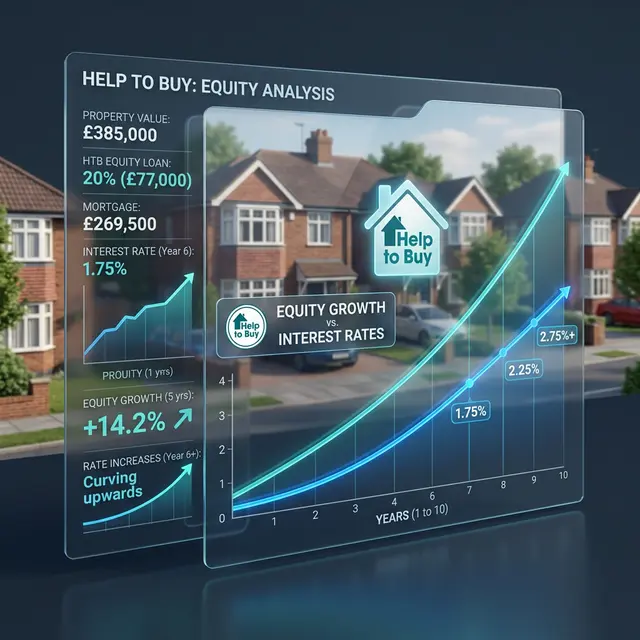
The 5-Year Honeymoon is Over: What Happens Now?
If you used the Help to Buy (HTB) equity loan scheme to purchase your home, the first five years probably felt like a fantastic deal. You secured a property with just a 5% deposit, and the government essentially lent you 20% (or up to 40% in London) of the purchase price completely interest-free. Aside from a nominal £1 monthly management fee, the equity loan sat quietly in the background, making your primary mortgage payments highly affordable.
But as the clock ticks closer to the five-year anniversary of your purchase, that honeymoon period comes to an abrupt end. For many homeowners, the transition into Year 6 represents a significant and often misunderstood financial shock: the Help to Buy interest trap.
From the first month of Year 6, the government starts charging you a monthly interest fee on the equity loan. It is vital to understand that this is an interest-only fee—your payments do not reduce the actual size of the loan you owe. You are simply paying for the privilege of continuing to borrow the money.
Critical Concept
Do I pay interest on the original HTB loan amount or current value?
You pay interest fees based on the original amount you borrowed, not the current market value of the property.
This fee starts at 1.75% of the original loan amount. However, the true danger lies in how this interest rate behaves in the years that follow.
How Help to Buy Interest is Calculated: The Escalation Math
The most dangerous aspect of the Help to Buy scheme is that the interest rate is not fixed. It is designed to escalate aggressively over time, far outpacing standard mortgage rates. The exact formula depends on when you took out your loan.
For Loans Issued Between 2013 and 2021
If you purchased your home under the original Help to Buy scheme, your interest rate increases every April by the Retail Prices Index (RPI) measure of inflation, plus an additional 1%.
For example, if RPI inflation is 5%, your Help to Buy interest rate will increase by 6% (5% + 1%). Note: This doesn't mean the rate becomes 7.75% (1.75% + 6%). It means the rate itself increases by 6%. So, a 1.75% rate becomes 1.855%. The following year, the new rate increases again.
For Loans Issued Between 2021 and 2023
In the final iteration of the scheme, the government changed the formula. For these loans, the interest rate increases every April by the Consumer Prices Index (CPI) measure of inflation, plus an additional 2%.
Because CPI + 2% is a highly volatile metric, homeowners are entirely at the mercy of macroeconomic inflation trends. During periods of high inflation, like the UK experienced recently, the cost of servicing the Help to Buy loan can skyrocket.
Common Question
Will my Help to Buy fees ever go down?
No. The interest rate formula is designed so that the rate only ever ratchets upwards. Even if inflation is 0% or negative, your rate will still increase by the minimum threshold (1% or 2% depending on your scheme iteration) every single April.
The "Shadow Cost": How Rising House Prices Eat Your Equity
While the rising interest fees are painful, they are actually only the visible part of the iceberg. The most significant financial drain of the Help to Buy scheme is what we call the "Shadow Cost": the impact of property appreciation.
When you took out the equity loan, you didn't borrow a fixed sum of money; you borrowed a percentage of your home. If you borrowed 20% to buy a £250,000 house, the government lent you £50,000. However, if your home’s value increases to £300,000 over five years, you no longer owe £50,000. You owe 20% of the new value: £60,000.
That £10,000 increase in debt is the shadow cost of Help to Buy. You are effectively losing 20% of your home's capital appreciation to the government.
When you sit down to calculate the true cost of keeping your Help to Buy loan in Year 6, you must combine both factors:
- Cash Flow Cost: The monthly interest payments (which only go up).
- Capital Cost (Shadow Cost): 20% of your home's annual growth in value.
Because property prices historically double every 10 to 15 years in the UK, holding onto the equity loan long-term means you are voluntarily giving away a massive portion of your future wealth. When calculating whether to remortgage or keep the HTB loan, the true "effective" interest rate of the HTB loan is the nominal interest rate plus your property's growth rate.
Long-Term Projections: The "10-Year Doubling" Phenomenon
Human brains are notoriously bad at intuitively understanding compound interest. Let's look at a deterministic long-term projection.
Assuming an original loan of £60,000, your year 6 payments start at roughly £87.50 per month (£1,050 per year). This seems manageable. It might even seem cheaper than taking on £60,000 of extra mortgage debt at 4.5%.
However, let's fast forward using a modest assumption of 3% inflation. Because the rate increases by CPI + 2% (effectively 5% compound growth on the rate itself every year):
- Year 6: £87.50 / month
- Year 10: £106.36 / month
- Year 15: £135.74 / month
- Year 20: £173.24 / month (Nearly double the original fee)
All the while, you are paying this money straight to the government, building zero equity, and watching the principal amount you owe grow alongside house prices.
Taking Action: To Remortgage, Staircase, or Sell?
The mathematics overwhelmingly point to one conclusion: taking action before or immediately at the 5-year mark is the optimal financial strategy for the vast majority of homeowners.
Your primary options are:
1. Remortgage to Repay (Full Buyout)
This involves increasing your main mortgage to borrow enough to pay off the 20% equity loan entirely. While your mortgage payments will increase, you instantly stop the mounting HTB interest fees and, crucially, secure 100% of your home's future capital appreciation. You transition from paying a fee for borrowing to actively paying down debt and building wealth.
2. Partial Repayment (Staircasing)
If you cannot afford to swallow the entire 20% loan into your mortgage, you can "staircase" by paying off half of it (10%). This halves your monthly interest fees and reduces the government's share of your future property growth from 20% to 10%.
3. Sell the Property
If you have outgrown the home, selling triggers the mandatory repayment of the loan from the sale proceeds. You keep 80% of the profits, the government takes 20%, and you move on without the HTB debt hanging over you.
How to Model Your Future HTB Costs
Every homeowner's situation is unique. The "Crossover Point"—the exact month where it becomes mathematically cheaper to remortgage rather than keep the Help to Buy loan—depends entirely on your specific property value, your original loan size, current mortgage rates, and your localized property growth rate.
Generic advice isn't enough when tens of thousands of pounds are on the line. You need deterministic, data-driven projections.
That is why we built the BuyBack HTB Calculator. By inputting a few simple details, our algorithm projects your exact costs over the next 30 years. It models the escalating HTB interest alongside your property's appreciation to show you precisely how much wealth you are losing to the shadow cost, and exactly how much you could save by remortgaging today.
Don't wait until the Year 6 interest fees start hitting your bank account.
Ready to find out exactly when to remortgage?
Use our data-driven calculator to project your Help to Buy costs and discover your personal Crossover Point.
Calculate My Break-Even Date Now