 BuyBack HTB
Remortgage vs. Keeping Your Help to Buy Loan: How to Find Your Crossover Point
The Dilemma: Keep the Equity Loan or Remortgage?
As the 5-year interest-free period on your Help to Buy (HTB) equity loan comes to an end, you face a critical financial crossroad. Do you keep the equity loan and start paying the escalating interest fees, or do you remortgage to buy out the government's share entirely?
Staying in the scheme keeps your primary mortgage balance lower, which might seem safer on paper. However, it exposes you to unpredictable, inflation-linked interest hikes on the HTB loan, and forces you to surrender 20% of your home's future capital growth. On the other hand, remortgaging to absorb the debt into a traditional mortgage stops the HTB fees and secures 100% of your property's future appreciation, but it significantly increases your monthly mortgage payments today.
How do you choose between the two? The answer isn't subjective. It comes down to a precise, calculated metric: The Crossover Point.
Understanding the "Crossover Point"
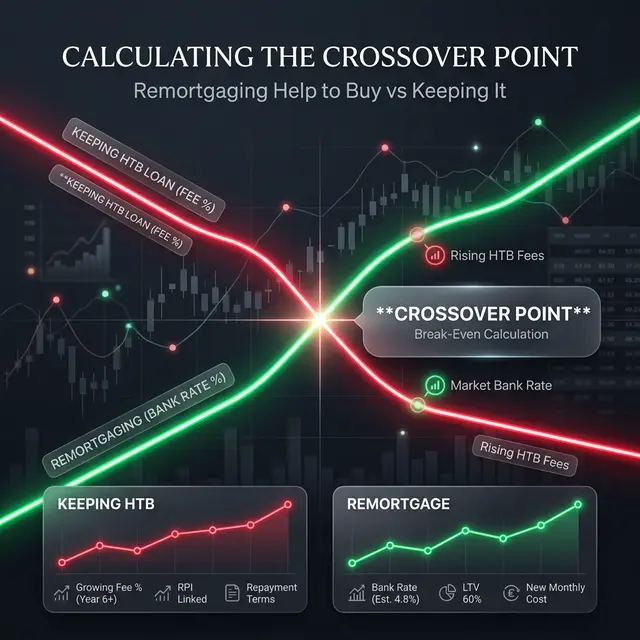
The Crossover Point is the exact mathematical moment where keeping the Help to Buy loan becomes more expensive than taking out a standard bank mortgage to pay it off.
To find this point, we have to look past the nominal 1.75% HTB interest rate. Because the government owns a percentage of your property, any increase in your home's value is effectively a cost to you (the "shadow cost"). Therefore, the true, effective interest rate of your Help to Buy loan is:
HTB Fee % + Annual House Price Growth % = Effective HTB Rate
If your HTB fee is currently 2% and your house is growing in value by 3% a year, your effective borrowing cost from the government is 5%. The Crossover Point is reached when:
The Golden Rule
Bank Mortgage Rate < (HTB Fee % + Annual House Price Growth %)
When the interest rate a bank offers you is lower than your combined effective HTB rate, you have crossed the threshold. It is now mathematically cheaper to remortgage and buy out the government.
The Impact of Loan-to-Value (LTV) on Remortgaging
There is a catch. When you roll the 20% equity loan into your main mortgage, your total borrowing increases. This changes your Loan-to-Value (LTV) ratio.
For example, if you have 10% equity, an 70% primary mortgage, and a 20% HTB loan, your bank currently views you as a 70% LTV borrower. They will offer you their best interest rates. If you absorb the HTB loan, you suddenly need a mortgage for 90% of the property's value. Your LTV spikes to 90%.
Banks charge higher interest rates for higher LTV brackets because the lending is riskier. By absorbing the HTB loan, you might inadvertently push the interest rate up on your entire mortgage balance.
Common Question
Can I roll my Help to Buy loan into my mortgage?
Yes, through a remortgage, subject to affordability checks and standard LTV limits. Most lenders cap lending at 90% or 95% LTV.
The "Blended Rate" Calculation
Because absorbing the HTB loan might increase your primary mortgage rate, you must calculate the "Blended Rate" to make a fair comparison.
Let's say your remaining mortgage is £150,000 at 4.5% (70% LTV). Your HTB loan is worth £50,000. To remortgage and buy it out, you need a £200,000 mortgage. But because you are now at 90% LTV, the bank offers you 5.5%.
You aren't just paying 5.5% on the £50,000 you borrowed to pay off the HTB loan. You are now paying an extra 1% (5.5% - 4.5%) on your original £150,000 mortgage as well. When you calculate the true cost, that £50,000 top-up loan is effectively costing you much more than 5.5%. This is why generic advice fails.
Common Question
Is it cheaper to pay off Help to Buy early?
Yes, if your property is increasing in value steadily, or your HTB interest rate (which is tied to inflation) is projected to surpass standard mortgage rates. However, if your property value is stagnant and inflation is rock bottom, the math shifts.
Find Your Crossover Point Instantly
Calculating the Blended Rate, forecasting inflation-linked HTB fees, and estimating property growth over a 30-year period is incredibly complex to do manually.
We built the BuyBack HTB Calculator to do this deterministic math for you. By entering your current mortgage details, property value, and projected growth rates, the tool automatically calculates both your Effective HTB Rate and your Blended Remortgage Rate.
The system will map these two trajectories over time and visually pinpoint your exact Crossover Point. Stop relying on subjective guesswork. Use data to find the optimal month to remortgage, pay off your equity loan, and secure your financial future.
Ready to find out exactly when to remortgage?
Use our data-driven calculator to project your Help to Buy costs and discover your personal Crossover Point.
Calculate My Break-Even Date Now